
7 lamination defects that start in the machine
MOST RECURRING LAMINATION DEFECTS ARE MACHINE AND PROCESS PROBLEMS, NOT MATERIAL PROBLEMS.
Silvering, air entrapment, tunneling, wrinkles, adhesive bleeding, curl and telescoping all trace back to nip pressure, web tension, roller alignment or winding settings. A defect that responds to a machine setting is not a film fault.
Lamination defects almost always trigger the same first phone call: to the film supplier. The roll passed every incoming inspection, the datasheet is in order, and yet the laminated product shows silvering, bubbles or curl. Before anyone questions the machine, the material is on trial. At Crest Dutch Machinery we have built and rebuilt industrial laminating machines for more than four decades, and we see the same pattern on production floors across Europe: the majority of recurring lamination defects are process and machine issues, not material issues. This guide covers the seven most common ones, what actually causes them, and the questions that separate a film problem from a machine problem in minutes.
Where the defects come from
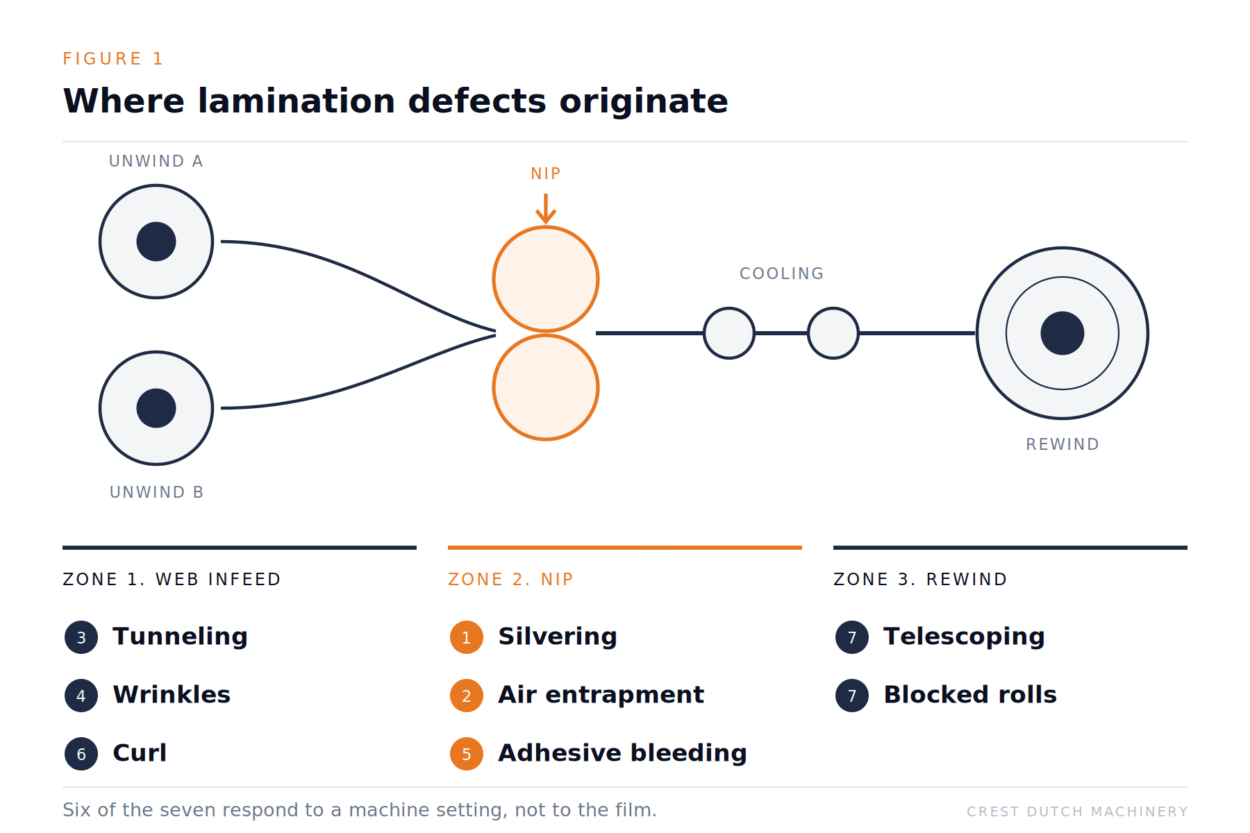
Six of the seven most common lamination defects originate before or at the nip. Only telescoping and blocked rolls are created at the rewind. Each defect maps onto a zone of the line, and each zone points to a different setting.
Figure 1. Each defect maps onto a zone of the line.
1. Silvering: uneven nip pressure, not the adhesive
Silvering is the fine pattern of microscopic air inclusions that gives a laminate a dull, grey shimmer instead of full optical contact. It is routinely blamed on the adhesive. In practice it usually points to insufficient or uneven nip pressure. Long nip rollers deflect under load, so pressure drops in the centre of the web while the edges look fine. A crowned roller, a stiffer roller construction or a properly set pneumatic nip solves what no adhesive reformulation ever will.
2. Air entrapment and bubbles: the nip entry decides
Visible bubbles are trapped air, and air gets trapped at the nip entry. The usual suspects: line speed too high for the nip geometry, a wrong web entry angle, or a laminating roller with worn or glazed rubber. On a well-configured machine the web approaches the nip so that air is squeezed out ahead of contact. If bubbles appear only above a certain speed, the machine is telling you where its limit is.
3. Tunneling: a tension mismatch frozen into the product
Tunneling, the tunnel-shaped delamination that appears hours or days after lamination, is a tension mismatch frozen into the product. One web was laminated under higher tension than the other; after winding, the stretched web relaxes and releases. The fix is independent, accurate tension control on every unwind, not a more aggressive adhesive. Machines that control tension with a manual friction brake are structurally prone to this defect.
4. Wrinkles and creases: an alignment problem, full stop
Wrinkles form when the web is not flat and evenly tensioned entering the nip. Causes are mechanical: rollers out of parallel, a worn spreader roller, tension set too low for the material, or a misaligned unwind. Thin films and stretchable substrates such as foam amplify every one of these. A wrinkle that always appears at the same web position is an alignment problem, full stop.
5. Adhesive bleeding at the edges: too much pressure, too much heat
Adhesive bleeding, also called ooze or squeeze-out, is adhesive pressing out at the edges of the laminate. It contaminates rollers, builds up on slitting knives and glues finished rolls together. It is caused by too much nip pressure, too much heat, or both. Operators often raise pressure to fight silvering and create bleeding instead. The real answer is uniform pressure across the width, which lets the total pressure stay moderate.
6. Curl: asymmetry carried in from the process
A laminate that will not lie flat carries asymmetry from the process: unequal web tensions, or heat applied to one side only. Curl is a specification killer in applications such as traffic signage, glass interlayers and panel lamination. On the machine side it is solved with balanced tension control and, where heat is used, controlled heating on the correct side or both sides.
7. Telescoping and blocked rolls: the rewind is still your problem
Defects at the very end of the line still land on the film supplier’s desk, because the customer discovers them when unwinding your material’s laminate. Telescoped rolls and blocked, self-adhering rolls come from wrong winding tension, a missing taper tension profile, or the wrong winding principle for the product. Soft, thick or freshly laminated products often need center winding with taper tension, and in some cases coreless winding. A rewind that winds everything the same way will eventually damage something.
What this means if you sell film
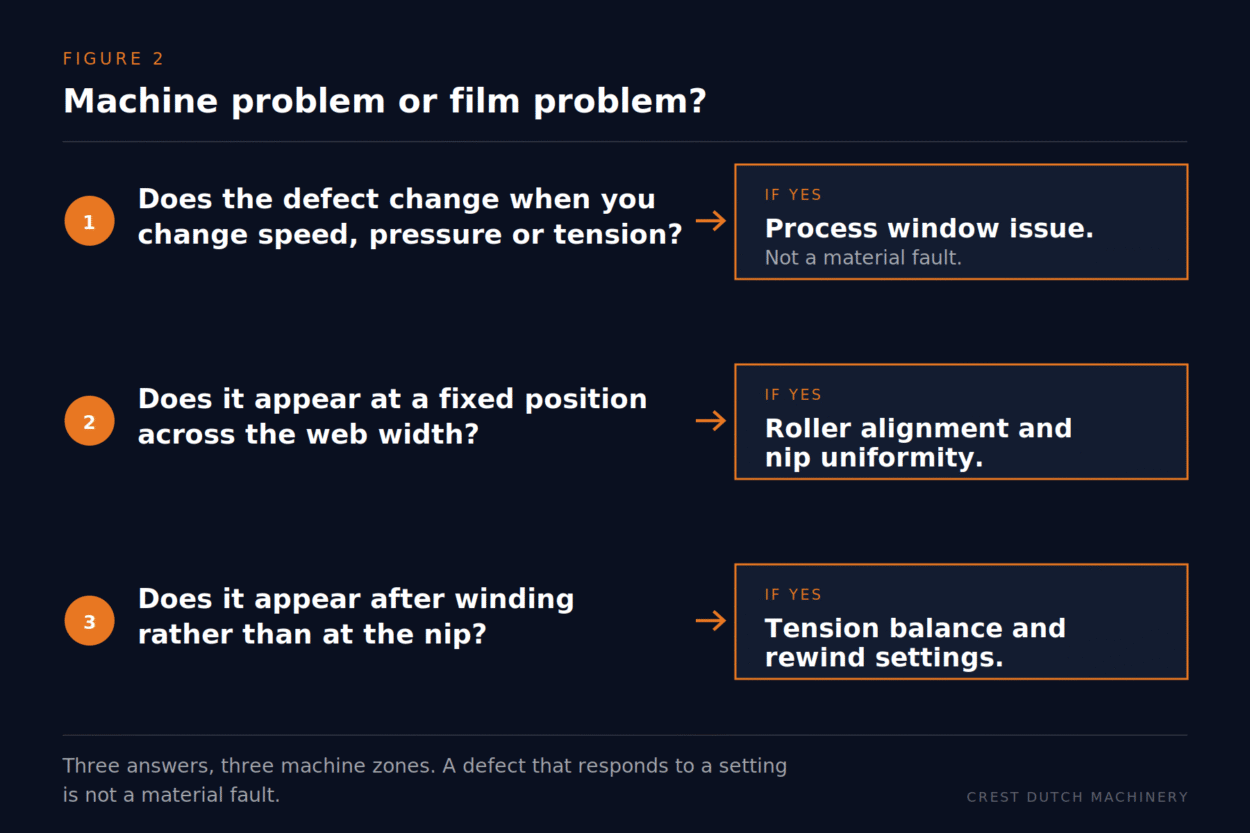
If you are the account manager standing next to an unhappy converter, three questions locate the problem fast.
Does the defect change when you change speed, pressure or tension? If yes, it is a process window issue, not a material fault.
Does it appear at a fixed position across the web width? If yes, look at roller alignment and nip uniformity.
Does it appear after winding rather than at the nip? If yes, the answer is in tension balance and rewind settings.
Three answers, three machine zones. Answering them turns a complaint call into a consultative visit.
Live · Crest Tech Session #1 · 24 & 25 November
Why laminations fail (and why it’s usually not the material)
We take three of these defects apart live: bubbles, wrinkles and delamination. What you see, what gets blamed, and which machine setting actually fixes it. Online, 30 minutes, free. Three time slots, or watch the recording.
Frequently asked questions
Most recurring lamination defects such as silvering, bubbles, tunneling and curl are caused by machine and process factors: nip pressure, web tension, roller alignment and winding settings. Material faults exist, but they rarely produce a defect that responds to machine settings.
Silvering is caused by microscopic air inclusions, usually the result of insufficient or uneven nip pressure across the web width, often due to roller deflection on wide machines.
Tunneling is delamination in tunnel-shaped channels that appears after winding. It is caused by a tension mismatch between the two webs during lamination and is prevented with independent, accurate tension control on each unwind.
Adhesive bleeding, also called ooze or squeeze-out, is adhesive pressing out at the edges of the laminate. It is caused by excessive nip pressure, excessive heat, or both, and it contaminates rollers and slitting knives. Uniform pressure across the full working width lets the total pressure stay moderate.
Warning signs include a very narrow process window, defects that return with every new material, manual tension adjustment by feel, and scrap rates that spike on thin or stretchable substrates. A machine audit by a laminating machine builder gives a definitive answer.
Talk to a machine builder before the next escalation
A customer stuck on the same defect?
Send us the material, the width and the line speed. Our engineers will tell you whether the machine can be adjusted, retrofitted or has reached its limit. Crest Dutch Machinery is the European specialist in configure-to-order industrial laminating machines, and we look at the process together at no cost to your customer relationship.